
Sometimes it is important to give people their flowers – especially when (a) they do something that makes your life easier and (b) are already partners in crime.
In quick succession in recent weeks my collaborators on the Product for the People meet-up series shared things that immediately got added to my product coaching toolbox.
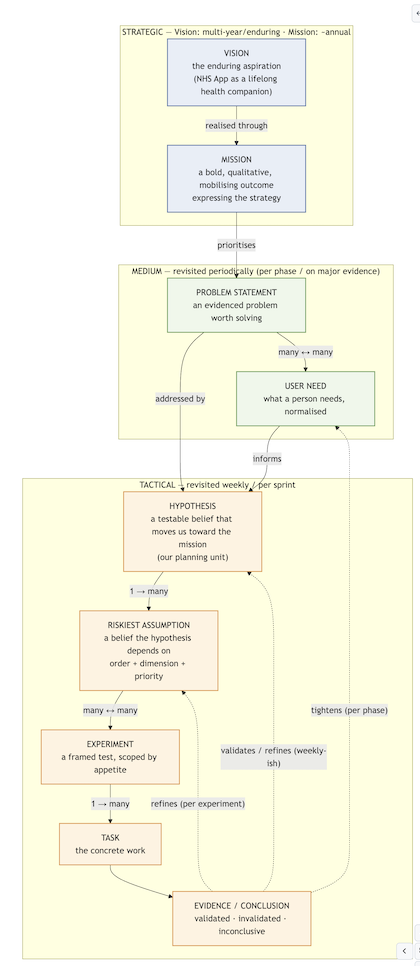
Steve wrote up his Alpha process (scroll down to ‘The Model’)- in the same weeknote where he was worrying about a crisis of confidence! – with a level of clarity and pragmatism I have never been able to articulate.
He also diagrammed his thinking out which I found incredibly useful immediately.
The part we care about is that problem statements and user needs are equal partners, not bolt-ons. They hang off the model right next to the hypotheses. That keeps us honest in two directions: the hypotheses pull us into the solution space and the language of ‘what change do we want to create’, while the problems keep us anchored to why any of it matters.
Debbie had her own shining moment (though it was actually Steve who introduced me to it) with the Department for Education Product Principles. All eight principles are brilliant but I am particularly in love with numero uno.
Principle 1: Set your vision, mission and strategy
Your vision should describe an outcome, not a solution. The outcomes should be measurable. It should be stretching and aspirational, but achievable. It does not need to be overcomplicated. You should make sure the scope of your vision is not too broad.
Your mission is your elevator pitch – a brief speech outlining what it is you’re doing. It should be easy for people to understand what you’re hoping to achieve.
Seven years ago this very month I wrote a post on Product Foundations (that thankfully the Wayback Machine rescued and that I will archive here one of these days) which covered a lot of what Steve and Debbie have – less well and that post will now be retired as I have better resources to point to.
Thanks both!


One response to “Credit where it is due corner”
[…] Jukesie – the Department for Education’s Product management […]