
This is a special edition coming to you ‘live’ from Hamburg where I have been attending the Product at Heart conference.
I took a LOT of notes which I am going to share below. I have tidied them up a [very] little and added some pics but they may still not make much sense…we’ll see.
From a big picture POV I’d really recommend the event to any product people (or product curious folk). It was a really strong line up, a great venue (though could have done with more toilets!), lovely food, free soft drinks for us non-coffee drinkers(!), easily accessible via public transport and all in all a triumph I think.
I don’t attend many product centric gatherings – tending to lean into public service digital or generalist events with some kind of tech for good pedigree but I’ll be returning to this one.

First keynote is Melissa Perri talking product ops – a new talk.
TL;DR
Melissa’s talk is a good intro to the concept of ProductOps (which was good as it dominated the conference). It seems to boil down to having good ResearchOps and sorting out access to data to make more informed decisions. Creating an enabling function (even a single person) that can free product managers up to concentrate on adding strategic value rather that being deep in the weeds.
She starts by talking about an issue with a CEO digging around in Jira looking for intel on what the product teams are doing to meet the goals of the org (and nobody can find anything in Jira 😆). There was a gap in what the teams articulated to operate and what the leadership needed to have access to for decisions and assurance.
It isn’t just about having good product skills but also the infrastructure to delivery product strategies.
3 pillars of product ops
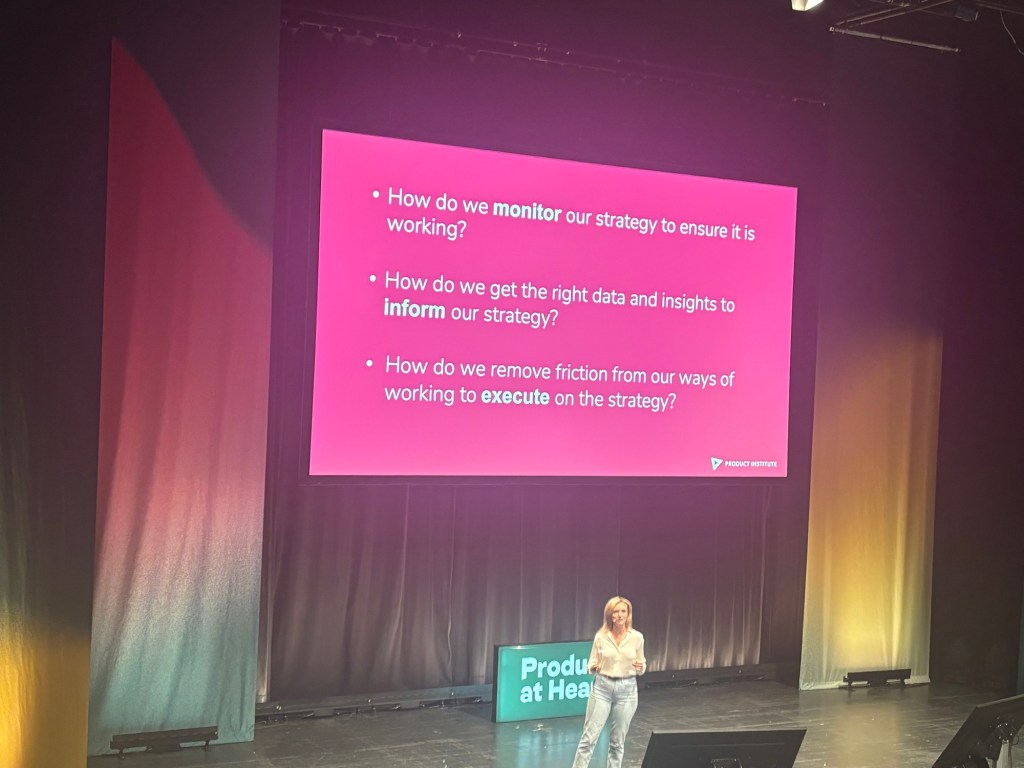
It is about thinking about the kinds of meetings, the cadence and the artefacts that make up planning – DESIGN the process to take good decisions.
Getting the right data to inform decisions is easier said than done – it’s scattered with teams, systems etc

User research is about more than interviews – it’s about identifying insights elsewhere with user interactions and prior work – it doesn’t always have to be fresh research.
A case for AI tools to do the aggregation (her take not mine!)
Dovetail – AI supported UR repo mentioned.
Do the hard work to make user research more targeted and impactful.
…and stop overwhelming our users with lots of requests for UR activity.
(I mean this is ResearchOps and pretty well established I thought)
The focus on processes , tools and governance gives product ops a bad rap and a lot of implementations in large orgs lean hard in and this puts people off.
(More Jira jibes 😆)
Swap SCS, Spads and Ministers for Sales 😆 promise nothing until it’s ready or decided 👌

Product Ops is about enabling not replacing. Ops are providing the infrastructure for PMs to focus on strategic product thinking 🤔

The second keynote is Oliver Reichenstein from iA 💕
Using iA Presenter in the wild!
TL;DR
Oliver’s pitch is basically what would product management look like if we removed time as a constraint and instead really invested in understand how things worked and how to deliver the very best product possible – however long that took. An accidental product person due to becoming the founder of a product company (iA) he is more philosopher than designer and more designer than product manager.
Verum factum – you can only understand something fully if you have made it yourself
To really understand beer you have to brew it 😆
The real value of science is experiments that rebuild nature (I think he talking Francis Bacon as well here 🤔)
Prototypes take time , things made truthfully feel more real but they take time…fast feels fake.
Imitation is easy. Innovation takes time. The cost of repetitive failures.
Products designed to fail and people don’t complain enough – we contribute to a mountain of waste in the world (fast fashion)
What is the opposite? Can you succeed by taking your time? Just focus on quality – launch when ready.
iA got tired of the bullshit of self imposed deadlines and timelines and roadmaps. Trusted the team to add value. Whenever.
A philosophy for iA Presenter about not putting too much on a slide – moving all that text behind the scenes or available elsewhere (very @undermanager.bsky.social )

Sold 3 million of iA Writer in 7 years – not Silicon Valley numbers but a good business.
Teachers love Presenter but corporate folk were too embedded with PowerPoint (only 2 people worked on it – one dev and one designer!)
They made a notebook because he wanted a physical product for writing that met his aesthetic…costs 70 euros 🤣
Took 10 years, cost about 500k and they sold 1000 (so far) 😆
Parallel tracks
Talk [01]
Compassionate Tactics – Emma Meurling
Stakeholders with solutions and complaints about delivery speed – trying to ‘educate’ them digital work – they cared nowt about discovery or the speed of coding, they didn’t even care about Marty Cagan 🙂
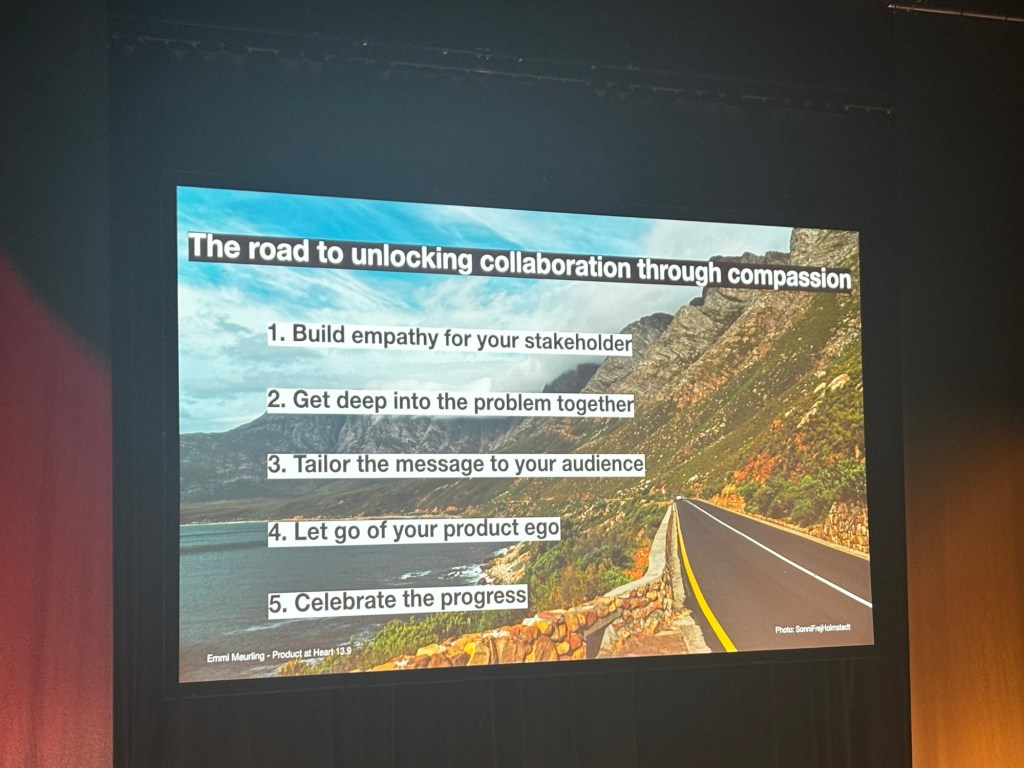
You need to start with compassion.
Compassion = Empathy + Action
Obstacle 1 – bad relationships with stakeholders – becoming frustration, defensive and avoidance.
You need to understand what motivates them – what do they care about – are measured on their success
Try and find some common ground outside of the job
It is usually not personal but about their pressures being passed on to you…
See the stakeholder you dread the most in the best possible light. It is about the success of the product and easier to change your own behaviours than someone else’s.
Collaboration starts with negotiation.
Moving past the solutioneering and get focused on the problems – implementing a Problem Canvas (another bloody canvas!)
Compassionate communication – tailor messages to the audience. What do they care about. How are they measured – what do they want to hear (for product releases).
Avoiding ‘the product ego’ – it gets in the way. PMs get caught up being dogmatic – wanting to do ‘perfect’ product (whatever that actually means) rather than being pragmatic (alongside being principled).
Pick fewer battles. Let it go.
Self-care. Fixing relationships takes time and isn’t always successful. Celebrate the wins – don’t just acknowledge the challenges/problems.
Talk [02]
Cross Functional Collaboration – Niamh Jones
From silos to success
What actually is the product? Is the internal view different to the customer perspective.
Systems thinking for product people.
Different teams doing similar work with similar goals but separately with different methods and metrics but the same customers.
Moving from lone wolf to a member of a pack – working collaboratively was better for everyone.
Product is a team sport.
Outcomes over Outputs.
Outcomes is a change in customer behaviours that leads to a business benefit.
Influence without authority – autonomy/mastery/purpose (Dan Pink)
Opportunity solution tree – producttalk.org/opperunity-solution-tree – working with multi-dis team to work through a tough problem meant they could identify trade offs and different opportunities. Diverse teams led to better products.
Talk [03]
Bruce McCarthy (author of Aligned)
Stakeholder management – the skills nobody teaches
VP of Marketing just not interested in promoting the new product he had come up with – he had a solid idea, some market fit but had no internal support (internal fit). Team Onion basically.
You don’t need to be good at politics to just be a genuine person.
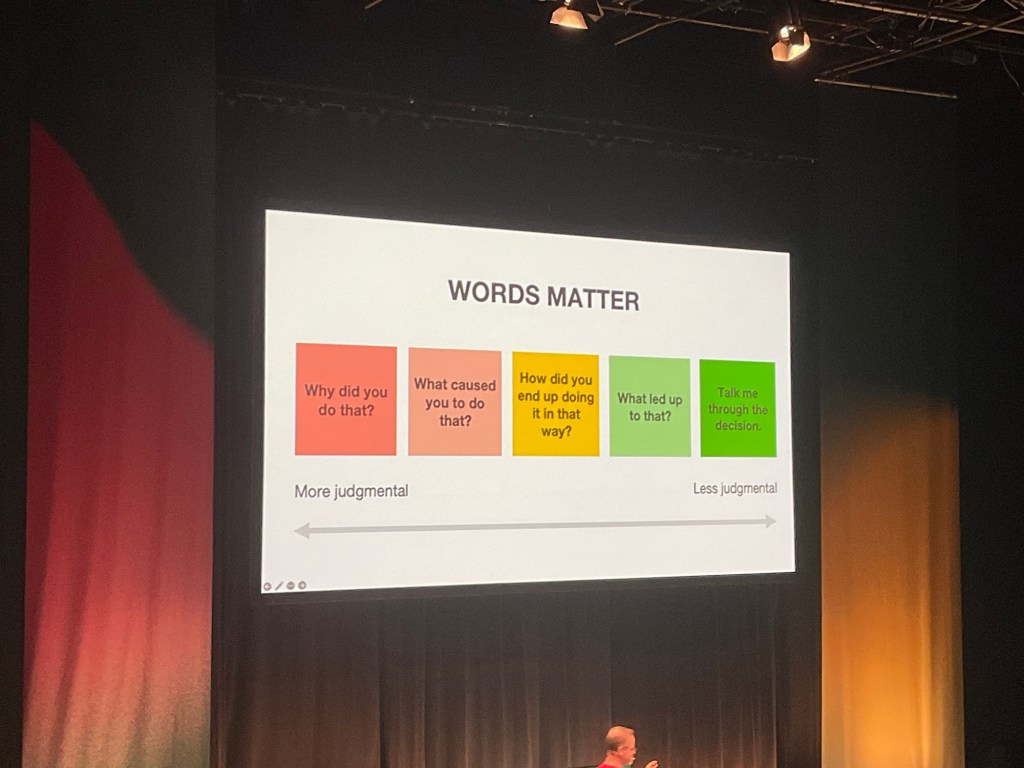
Words matter – avoid judgemental tone – be open, be curious. Have a real debate about whether the idea meets the real goal.
Because everyone enjoys talking about their own perspective given the opportunity
Treat stakeholder conversations like user interviews
Being dependable helped you build better stakeholder relationships
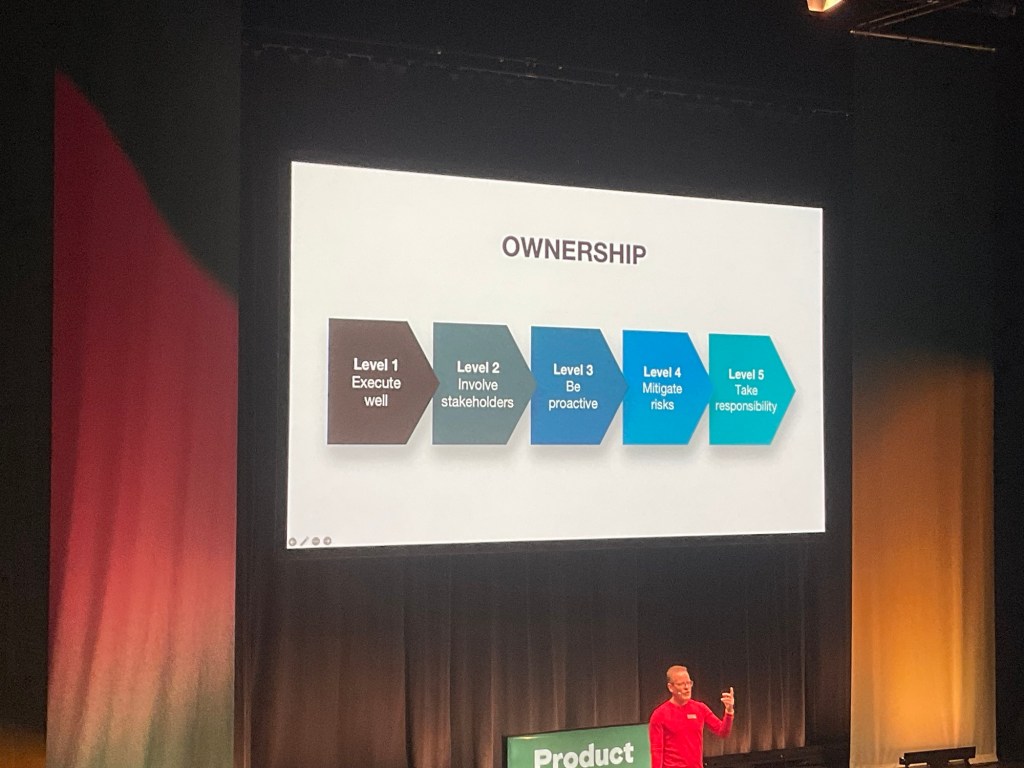
Delivery builds trust. It is about taking ownership.
You have to be open, collaborative, proactive. It is a team sport.

You need a roadmap that people rally around requires buy-in from EVERYBODY
Mine for conflict – find the hidden disagreements, get things on the table. Provoke responses.
The reporting org chart isn’t the influence org chart
The power graph is almost always different. It is often misleading.
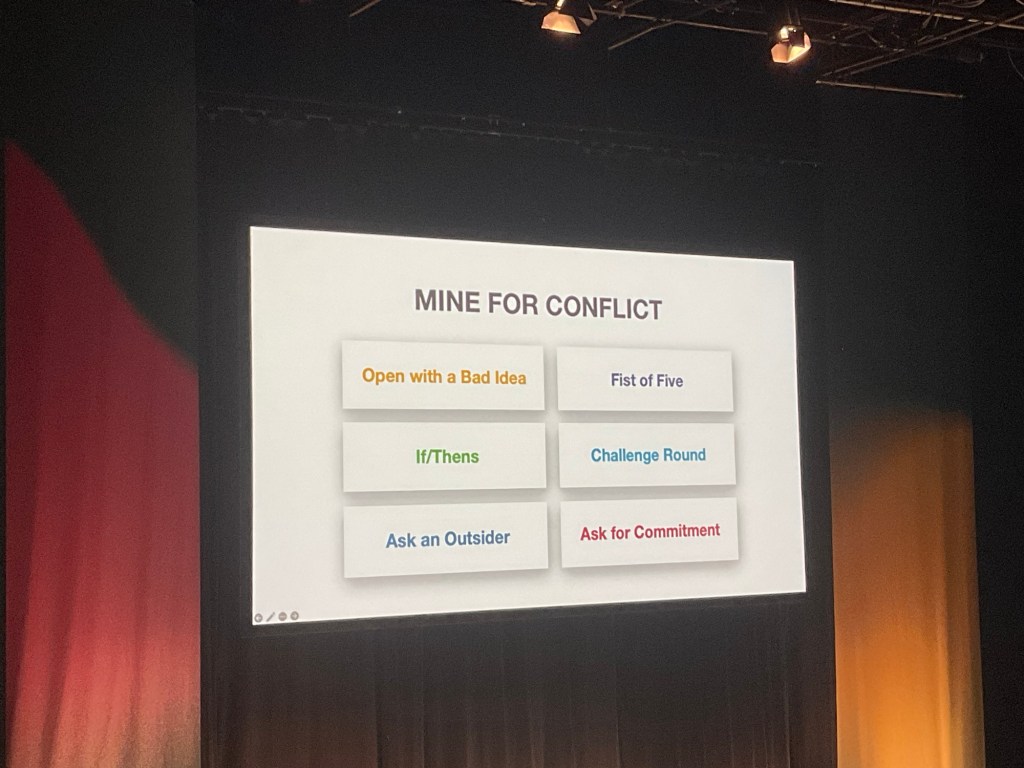
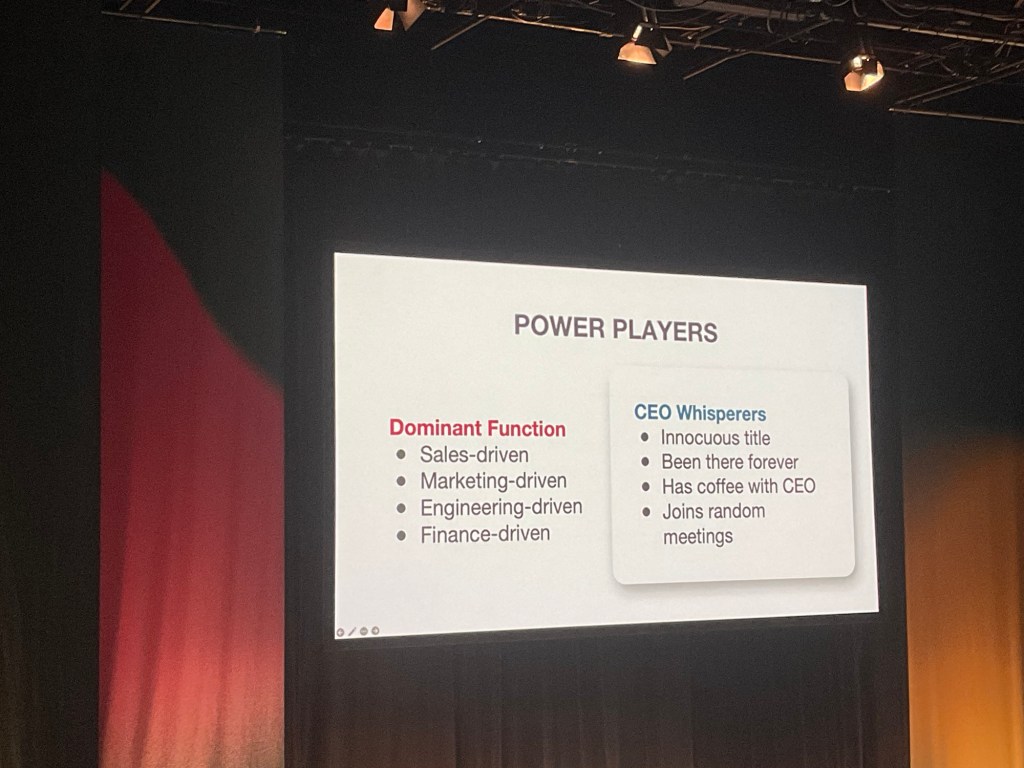
Haha – another bloody canvas – Stakeholder Canvas
There is almost always something you don’t know.
Talk [04]
Unstoppable (Tactics for moving forward) – Tsmer El-Hawari
Been in product for 20 years. The world has changed but there is a long way to go.
Conflicts about prioritisation, not enough data, too much burnout.
Focus – alignment – direction – insights
Non-negotiables (The fucking Bear)
The challenge of roadmaps are not delivery plans and how you communicate the difference
Be adaptable – meet stakeholders where they are – reframe the artefacts but stick to your principles – maintain your professional integrity – find your non negotiables
Why vs What if?
Understand the entire the entire ecosystem of the product – internal and external
Go wide but shallow with the research and pick the moments to go deep.
Too many options are as big a problem as too few – product strategy is vital (apparently – this all seems based on a very narrow definition of product/product management) Only 22% of product people believe their leadership has a clear strategy
Relevant > Traceable > Focus = Characteristics of Useful Product Objectives
Coherent actions to move from status quo > product objective > company objective
CIA meeting sabotage booklet – learn from it!
Tell stories – share insights

Talk [05]
No one size fits all – Flavia Neves
Your product approach needs to be context specific – the challenges are unique depending on where you are and who you work with.
It isn’t about a perfect model or framework – but playing the hand you are dealt where you are.
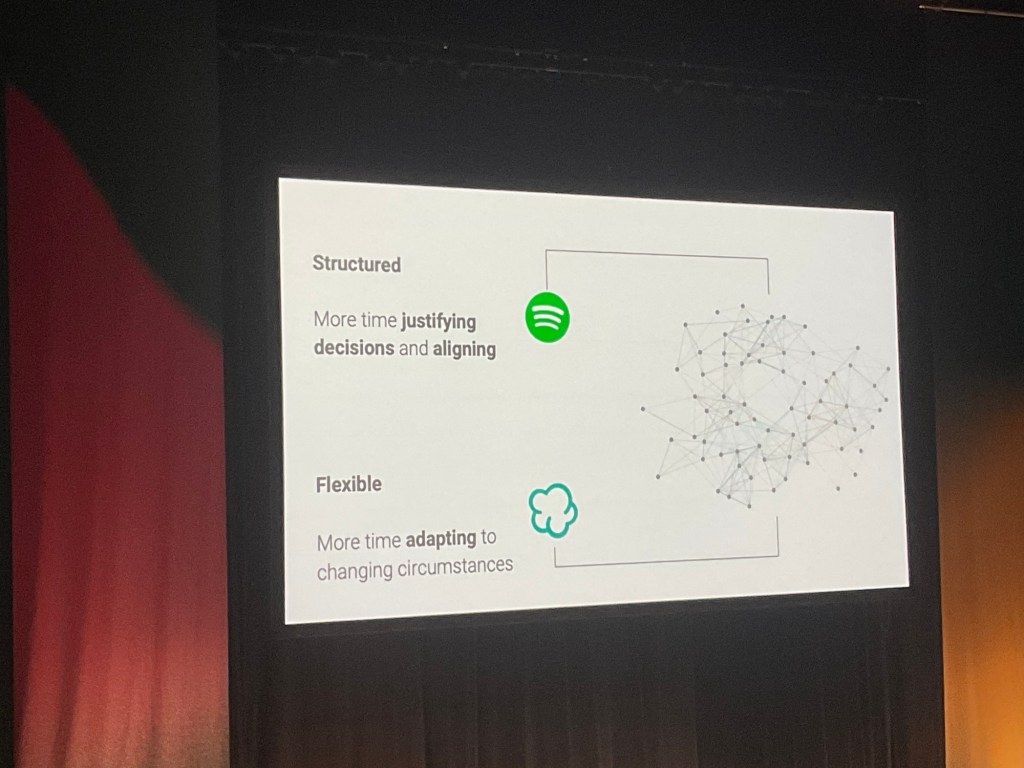
Spotify – chess game. Every move deeply analysed and prioritised. It is a machine. High barrier to entry and struggles to deal with the unexpected. Design upfront. Every step is sequenced.
Wallapop – poker game. Think on your feet. Evolving as you move forward – only planned a few moves ahead. You don’t know what cards are going to land.
Same objective – different game.
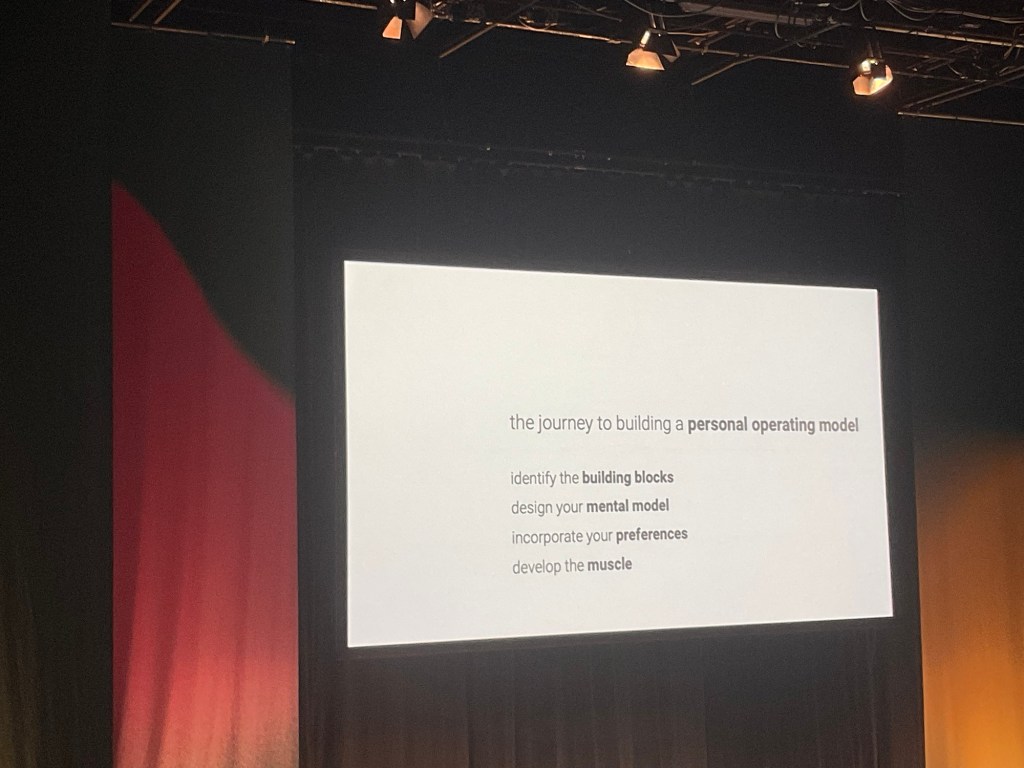
Product Operating Model vs Personal Operating Model
PMs trying to create perfect conditions – Marty Cagan isms
Agnostic approach to problem solving in product
Understand the recipes – the logic – of the frameworks but take the appropriate elements for the situation at hand rather than try to dogmatically follow anything
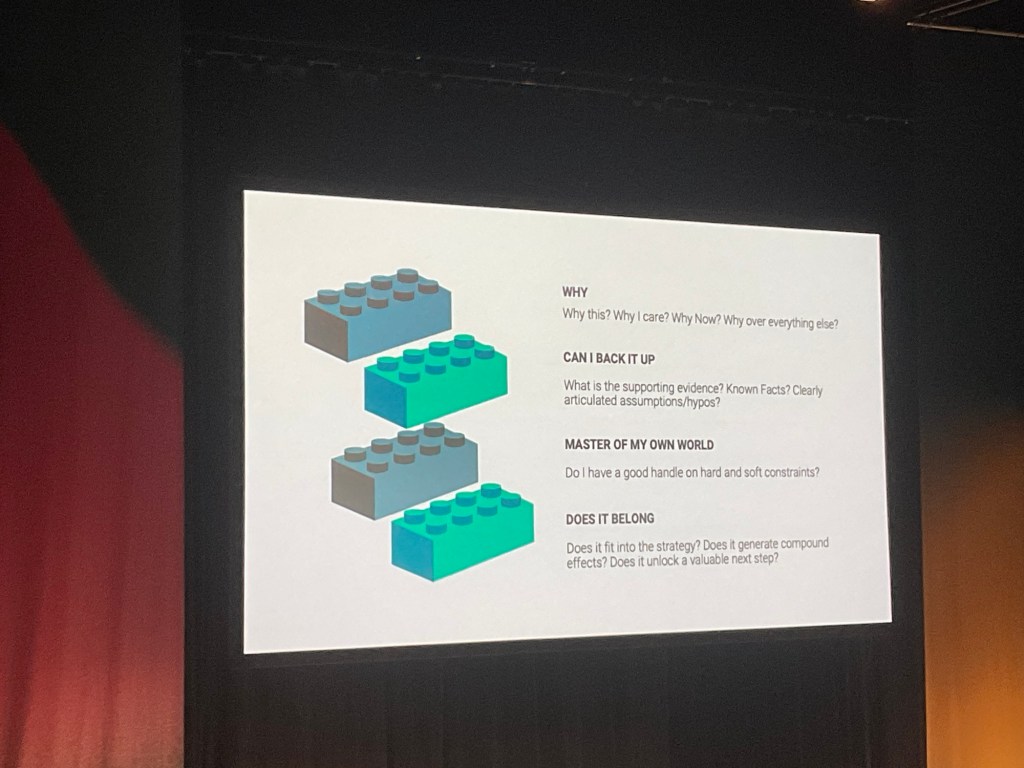
Spotify rely on articulating the value of their bets and how they contribute to the goals. Opaque process – hard to get prioritised and make it to the Bets Board. You need to have all the details, every angle and how it aligns with everything else going on.
Wallapop the pressure is on execution/delivery and collaboration but it is easier to try things – to run more experiment, adapting to what they learn on the fly.
Product management is making decisions. So having an approach you can bring to any situation to make decisions is vital and has nothing to do with the local product operating model.
Closing keynotes
The Practice is the Product: From Frameworks to Adapting for Context – Tim Herbig
Tim shared his slides which you can download below
Product cliche bingo – all about doing it ‘right’ – ticking the boxes
Product isn’t homework – we should be able to forge our own path…don’t hide behind the frameworks. Don’t follow the pack for the sake of it.
Alibi Progress – ‘correctness’ over progress/value
Advice is context dependent – James Clear
Strategy becomes mystical but it ends up just being the CEOs idea under the mask
Who is the product strategy for?
- External audiences don’t really care
- It is for your internal audiences
What is the problem strategy is trying to solve?
- It is about providing context for decision making
What does success look like?
- Are the teams focused?
A defined product strategy should make things clearer – like who should work on it, or which format works best…you do what works for your stakeholders.
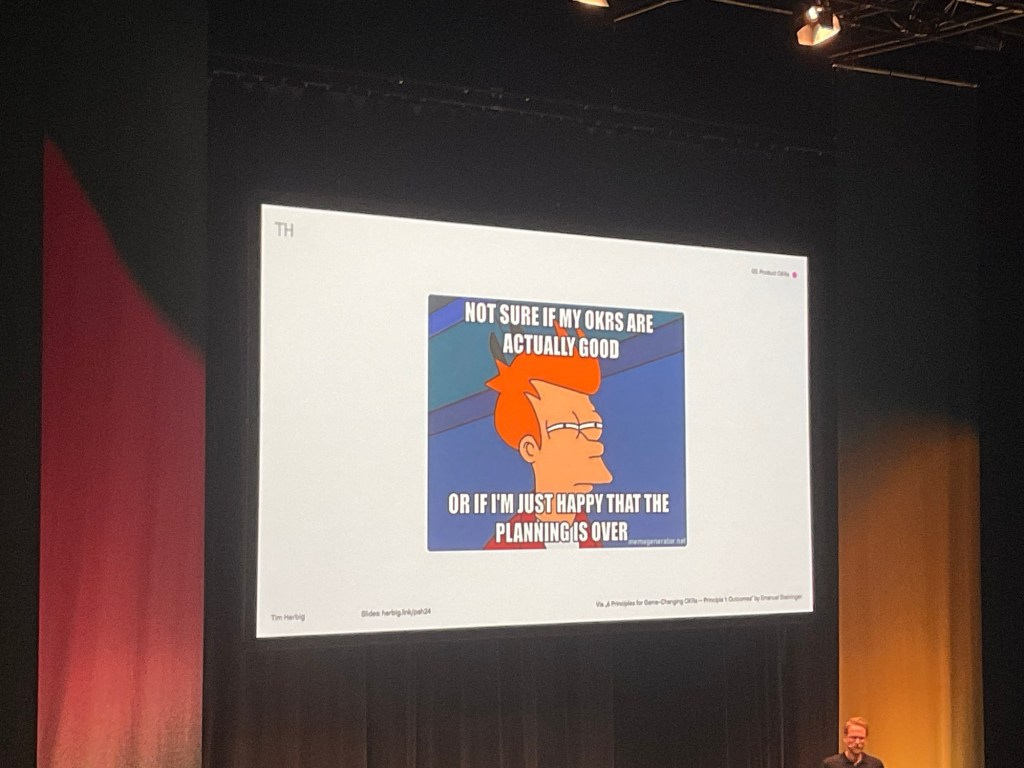
OKRs…lot of advice about how to do them ‘right’.
Teams should write their OKRs not receive them
Its the teams responsibility to have the inputs/evidence
Avoid evergreen metrics – a KPI in disguise
Don’t chase moonshots – 80% is the new 100%
Leading outputs over lagging outcomes
OKRs are visible in decision making moments
Non-OKRs tasks not eating your teams time
OKRs should be live throughout the quarter
\
Product Discovery
Sooooo many methods and frameworks – easy to get lost in alibi progress. Teams don’t adapt – just dogmatically follow the same approach.
All teams have to do discos the same.
Just following the phases doesn’t mean you have actually reduced uncertainty – just that you did all the steps. (GDS Product Lifecycle!)
Meet people where they are – sometimes you have to start with those solution conversations.
Real progress – prioritising value over correctness
How Personal Narratives Shape Our Products – Kate Leto
It’s All Invented!
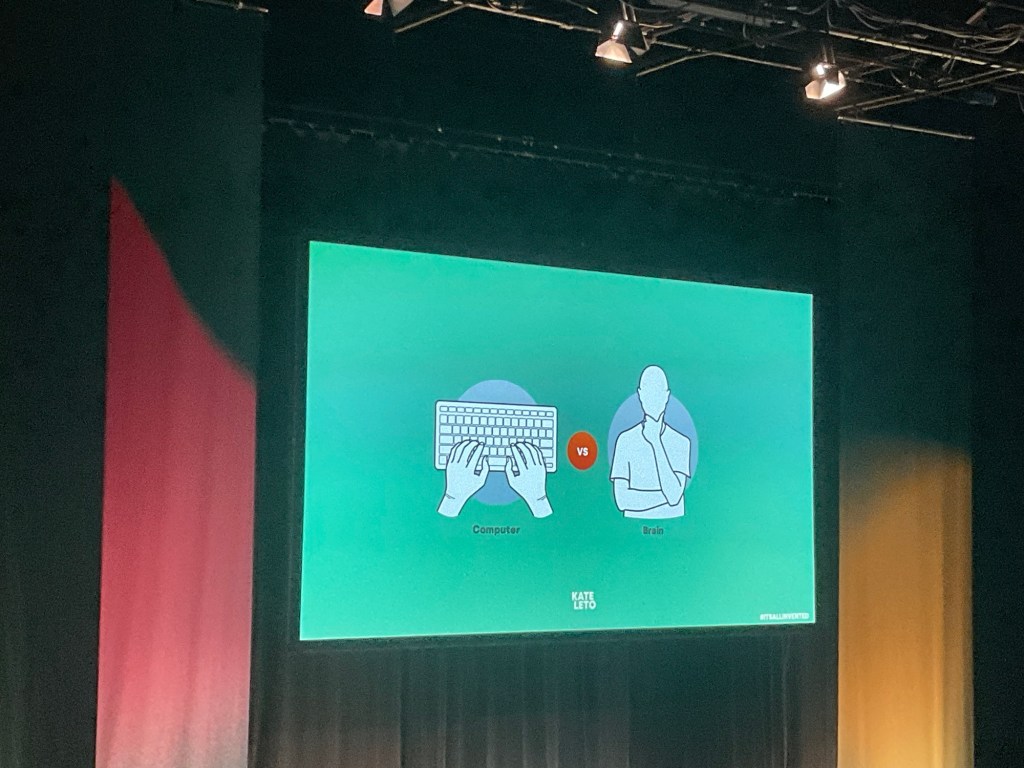
Kate coaches the person not the product. It is about self worth, identity, beliefs – the storylines people tell themselves lead to their behaviours.





Identify patterns
Understand purpose
Invent new possibilities (rewrite the story)
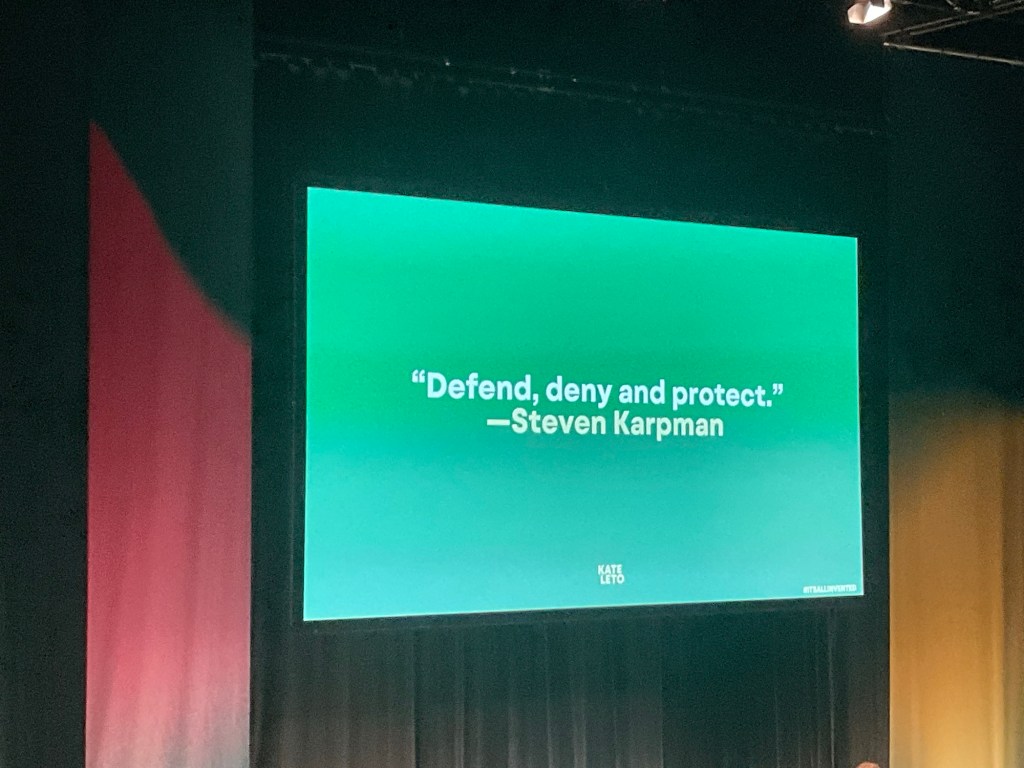
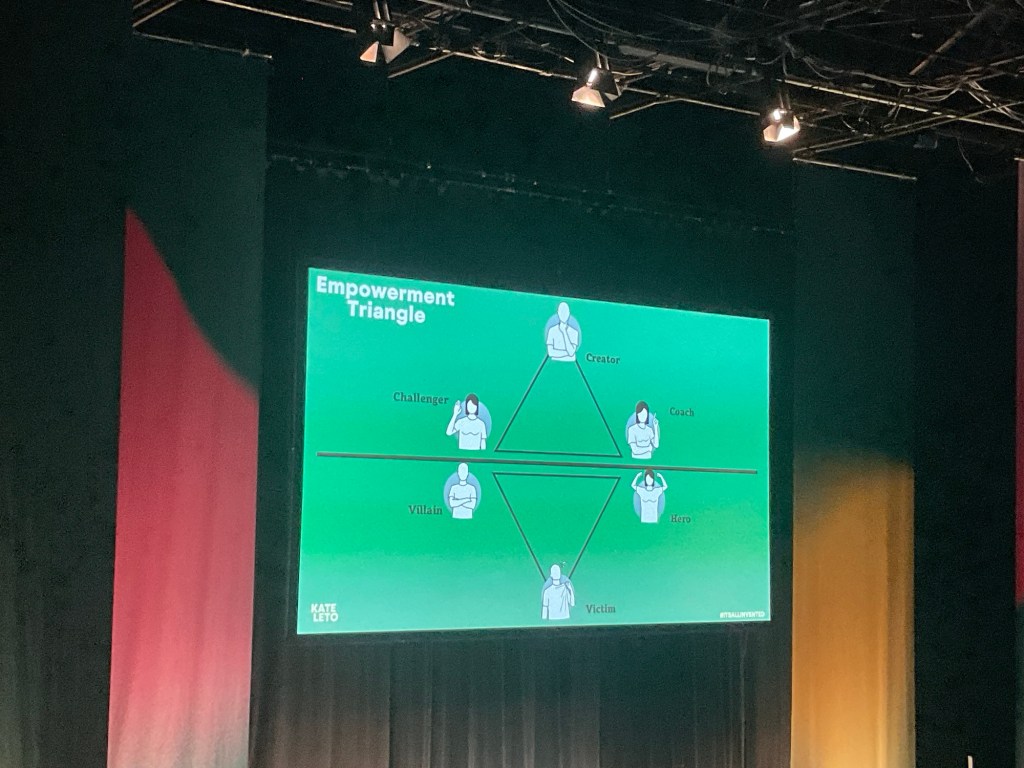
Patterns – villain / hero / victim at work (Karpman drama triangle)
The mythical leader – here to save the day 🙂
The hero has ulterior motives – they want it ‘done right’ – by which they mean ‘their way’. No room for teams/people to learn or grow.
The victim – they are stuck. They can’t make it happen. Too many blockers…but it is all they can see.
The chief finger pointer – it is always somebodies fault. Never them. They don’t contribute.
Our stories are always changing.
Defend, deny and protect – Karpman
Our stories are about helping us survive.
Our stories are a feature not a bug. They have purpose…but they are BUGGY.
(She keeps saying SnaggleTooth Tiger instead of Sabretooth Tiger – its distracting AF)
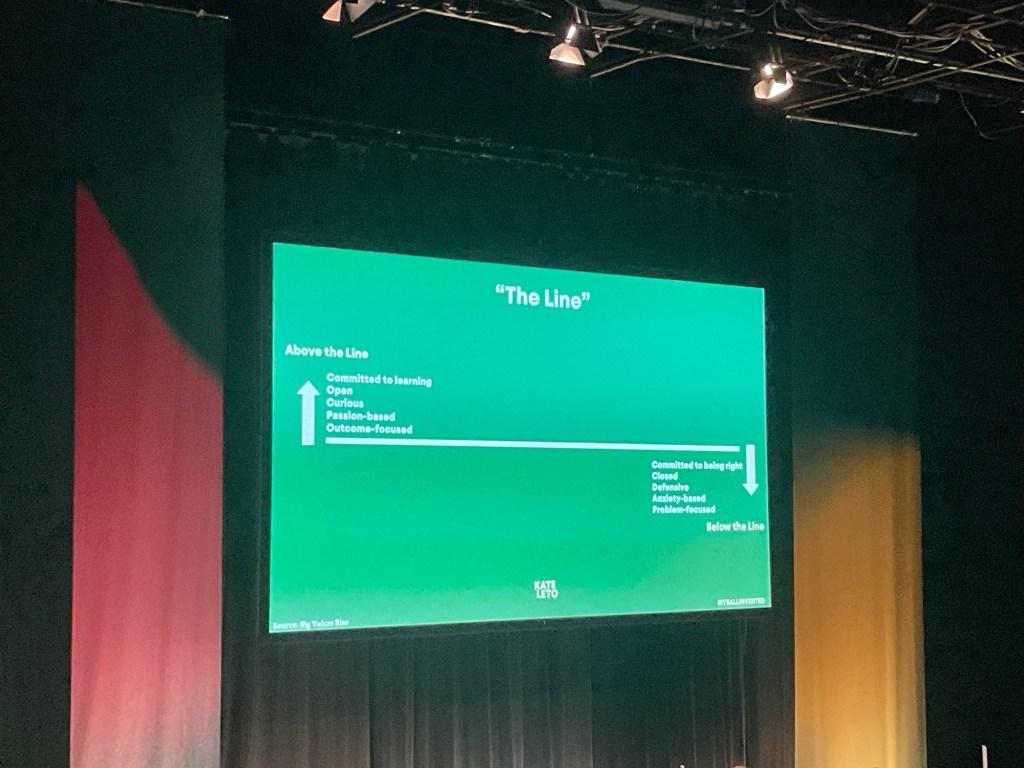
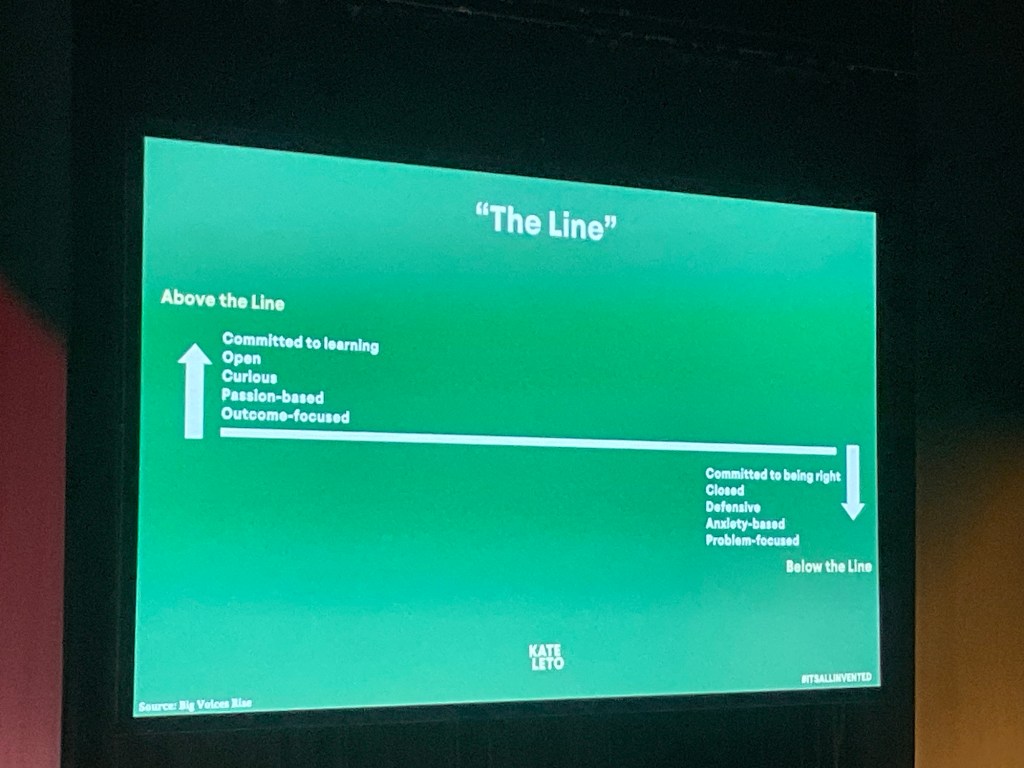
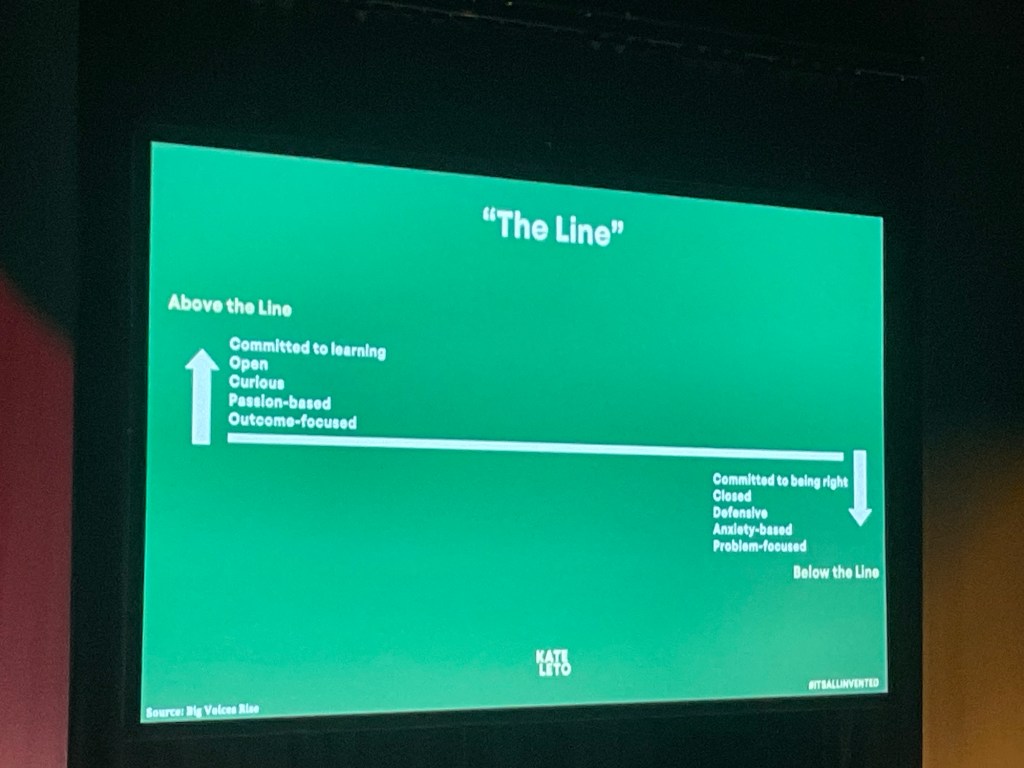
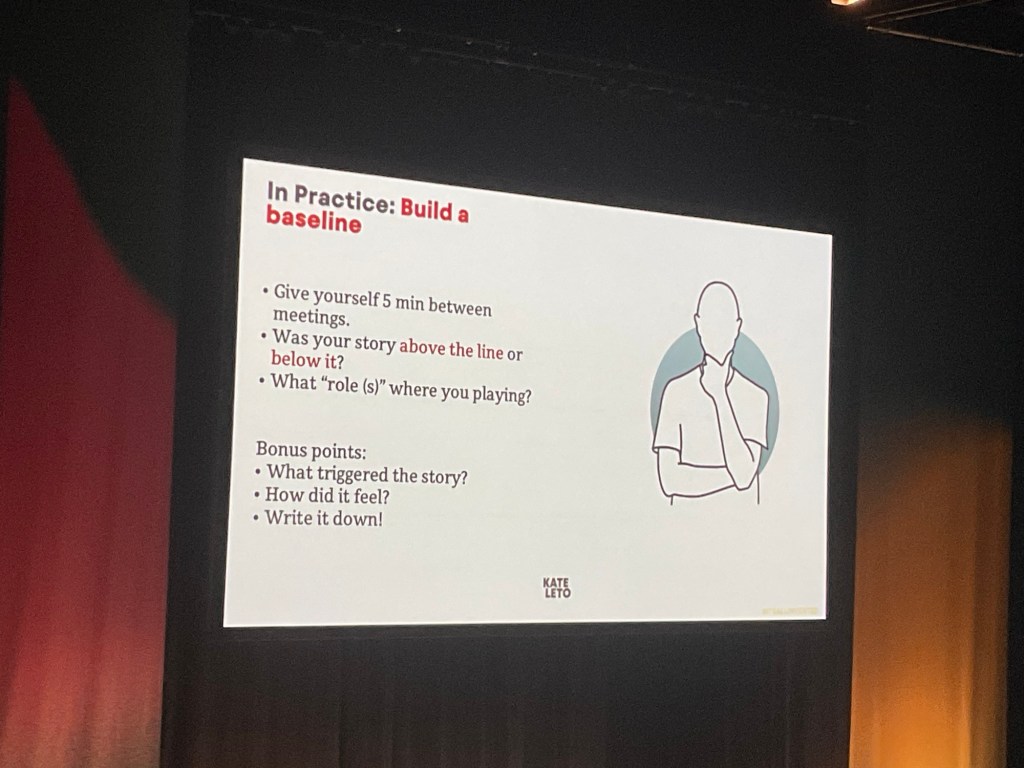
“The Line” – identifying the kinds of stories we are telling 80% of self narratives are below the line.
Creator – Coach – Challenger (Empowerment Triangle)
Coach – How can I help?
Creator – Seeing the many options. Curious and open
Challenger – Calls people out but in a collaborative manner way
How do we invent new possibilities – take time to think and change the way you do that thinking.
Where are you now?
Where do you want to go?\
How will you get there.
The Art of Possibility – Zander – Give Yourself an ‘A’
15% rule
You can’t change some else’s story. Focus on your own.
Put in the time.
Build your team.
Stories don’t stop at the office.
 Digital by Default